

549 points and 249 comments landed on the glm-5.3 launch on hacker news in less than a day. that is a lot of attention for a coding model, but it is not the interesting number.
the interesting part is that an open coding model can now arrive with a serious enough performance claim to make model choice feel ordinary. z.ai says glm-5.3 improves by 50 percent over its predecessor on its coding evaluation. take that as a vendor result, not a universal scoreboard, but the direction is hard to miss: the gap between “capable enough to build with” and “available outside one vendor’s app” keeps shrinking. the launch details are here:
my blunt take is that the model picker is becoming a weak product.
an indie maker can still charge for a useful workflow. charging because a user cannot reach a competent model is a much shakier plan. the model will be swapped, discounted, rate-limited, or copied into somebody else’s plan. none of that is a small possibility now. it is the normal weather.
deepseek’s new harness makes the same point from the other side. the developer preview calls itself an open-source agent harness where “everything is a plugin,” and warns that compatibility-breaking changes are coming. it can be launched locally with npx @deepseek-ai/dsh web. those are early-product details, not a polished platform promise, which is exactly why they matter. the harness is being treated as the thing that changes quickly while the model is only one replaceable part. read the project notes here:
that sounds like plumbing until a product has to survive a real Tuesday.
yesterday, between a coffee stop and tidying a small task panel for an indie-maker workflow, I caught myself comparing two model outputs when the actual problem was much duller. the task had retried after a tool timeout. the second run had lost the first run’s partial result. a better model might have made a nicer answer. it would not have told the user what had already happened, what had cost money, or whether it was safe to press run again.
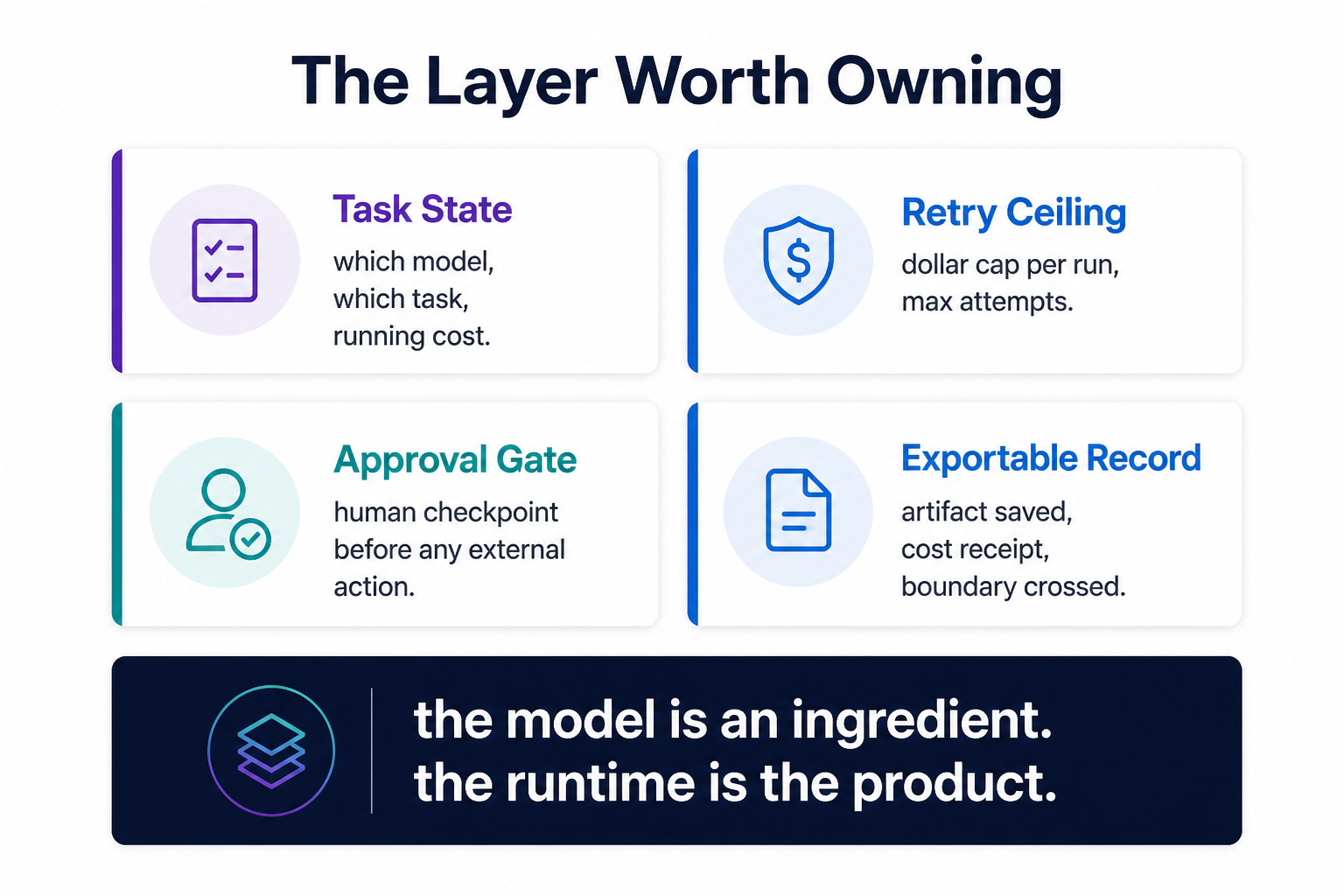
that is the layer worth owning. it decides which model gets a task, caps the retry bill, keeps the useful artifact, and shows a human when the system crossed a boundary. it also holds the awkward bits that no benchmark headline covers: permissions, customer-specific rules, source links, and the receipt for a failed action.
writer’s latest release is a useful commercial signal here. its new model is paired with an upgraded harness explicitly aimed at containing token costs, according to this report: the cost control did not get bolted onto the pricing page. it moved into the runtime, where context is assembled and turns are allowed to multiply.
this changes how i would scope a small ai product. i would keep a model adapter deliberately boring. one interface, a few supported models, no mythology about permanent allegiance. then i would put care into four things that users can actually feel: a visible task state, a retry rule with a dollar ceiling, an approval point before an external action, and an exportable record of the result. that record is not admin work. it is the reason a user can trust the next run.
the last item has become more important as agents touch files, browsers, and business tools. i wrote recently about how a pdf read by an agent can become an outbound request. the same boundary problem applies here: a flexible harness is useful only when it makes those boundaries easier to see and control. otherwise “plugin” just means more places for a surprise to hide.
there is a catch. open models do not erase infrastructure cost. they often move it. someone still pays for context, retries, observability, support, and the slow work of deciding when an agent should stop. a model price that looks wonderful in a demo can become expensive when the harness lets five uncertain tool calls bloom into twenty.
the next year of ai product building will reward teams that treat the model as an ingredient and the runtime as the product. glm-5.3 may win or lose any given benchmark. deepseek harness may change shape several times before it is stable. neither outcome changes the job in front of builders. make the work legible, bounded, and recoverable. that is where a small product still has something difficult to copy.